
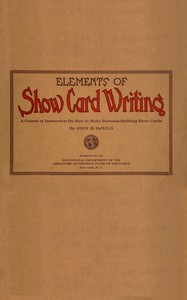
Elements of show card writing : A course of instruction on how to make…
Okay, let's be clear from the start: this is not a storybook. Published in 1919, Elements of Show Card Writing is exactly what the title promises—a practical course in creating hand-lettered signs for store displays, known as 'show cards.' Author John H. De Wild walks the reader through everything: the right brushes and paints to use, how to hold them, how to form basic letter styles (from simple block letters to fancy shaded ones), and how to layout a card for maximum effect. It's a step-by-step guide, assuming you start as a complete beginner.
The Story
There's no plot twist or character arc here. The 'story' is the instruction itself. De Wild methodically builds your skills, starting with straight lines and curves, then moving to whole alphabets, and finally to designing complete cards with borders and simple illustrations. He emphasizes practice, cleanliness, and pride in workmanship. The book itself is the narrative of mastering a tangible, useful skill that could earn you a living or at least help your own business stand out.
Why You Should Read It
You should read it because it's a time capsule. The magic isn't in learning to paint signs (unless you want to!). It's in the window it opens. De Wild's serious, dedicated tone shows how vital this craft was to daily commerce. In a world of digital fonts and printed vinyl, this manual reminds us that every public word was once made by hand. You get a real sense of the quiet artistry in a well-made price tag or a window announcement. Reading his careful instructions, you can almost smell the paint and see the focused apprentice in a back room, striving for that perfect letter.
Final Verdict
This book is perfect for history nerds who love the mundane details of the past, for artists and designers curious about the roots of typography and graphic design, and for anyone who enjoys holding a piece of obsolete technology in their hands. It's not a page-turner, but it is a quiet, thoughtful look at a vanished skill. If you've ever admired an old-fashioned sign and wondered, 'How did they do that?'—this book has your answers.
There are no legal restrictions on this material. It is now common property for all to enjoy.
Nancy Moore
5 months agoHaving followed this topic for years, I can say that the author’s unique perspective adds a fresh layer to the discussion. This should be on the reading list of every serious professional.
Richard Martin
2 months agoThe digital formatting makes it very easy to navigate.
Jennifer Garcia
9 months agoIt’s refreshing to see such a high standard of digital publishing.
Christopher Perez
4 months agoUnlike many other resources I've purchased before, the formatting on mobile devices is surprisingly crisp and clear. I am looking forward to the author's next publication.





Patricia Lee
2 months agoI found the author's tone to be very professional yet accessible, the case studies and practical examples provided add immense value. Truly a masterpiece of digital educational material.