
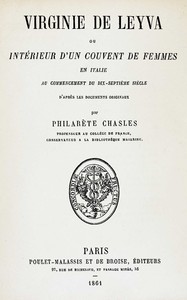
Virginie de Leyva : ou intérieur d'un couvent de femmes en Italie au…
First published in the 19th century, Philarète Chasles's Virginie de Leyva takes us inside the cloistered walls of an Italian convent in the 1600s. It’s a world far removed from our own, built on strict rules and silent obedience.
The Story
The book follows Virginie, a young woman from a noble family. She doesn’t have a religious calling; instead, she’s sent to the convent for social and financial reasons common for daughters of her time. Once inside, she discovers the convent is not a peaceful sanctuary. It’s a pressure cooker of human emotion. Beneath the surface of prayer and ritual, the nuns grapple with jealousy, ambition, loneliness, and forbidden passions. Virginie must learn the complex social codes of this closed society, navigating friendships, enmities, and the ever-watchful eyes of authority. The plot unfolds through her experiences, showing us the stark contrast between the convent’s holy reputation and the very human struggles happening within.
Why You Should Read It
What grabbed me was how modern the conflicts feel, even though the setting is centuries old. Chasles was ahead of his time in focusing so intently on a female-dominated space and the psychology of its inhabitants. This isn’t a story about nuns who are all saintly or all wicked. They’re portrayed as real people—some kind, some cruel, most just trying to make the best of a life they didn’t choose. Virginie herself is a compelling lens. We see her confusion, her small acts of defiance, and her search for identity in a place that seeks to erase it. The book asks big questions about freedom, duty, and where to find meaning when your path is chosen for you. It’s a fascinating, and sometimes heartbreaking, look at a slice of history through a very personal window.
Final Verdict
This book is perfect for readers who love historical fiction that focuses on character and social dynamics over sweeping battles. If you enjoyed the intricate politics and personal drama of books like Matrix by Lauren Groff or the confined setting of The Miniaturist, you’ll find a similar appeal here. It’s also a great pick for anyone interested in women’s history and stories of resilience. Fair warning: it’s a 19th-century narrative, so the prose has a different rhythm than modern novels, but the emotions and conflicts are instantly recognizable. Give it a chance, and you’ll be pulled into Virginie’s hidden world.
This work has been identified as being free of known copyright restrictions. You do not need permission to reproduce this work.
Susan Martinez
3 months agoGiven the current trends in this field, the level of detail in the second half of the book is truly impressive. A trustworthy resource that I'll keep in my digital library.
Kevin Thompson
1 year agoBased on the summary, I decided to read it and the emotional weight of the story is balanced perfectly. Don't hesitate to start reading.
Kenneth Thompson
4 months agoI have to admit, the plot twists are genuinely surprising. I learned so much from this.


Matthew Thomas
1 year agoOne of the most comprehensive guides I've read this year.